The dark side of sunscreen.
The one thing that 75% of cancer patients have in common.
As shocking as it sounds, your sunscreen is putting you at risk for all kinds of illnesses, including the very cancer and skin aging it’s supposed to protect against.
The British Association of Dermatologists recently released a study concluding that, as the respected Consumer Health Digest reports, “Sunscreen Causes Cancer.”1
And that’s not all. Sunscreen is behind one of the biggest health epidemics we face today, even though few people know about it yet.
An epidemic that not only causes cancer, but also some of the most widespread and dangerous health conditions today.
A study published in the International Journal of Health Sciences calls it “an ignored epidemic,” and says that “no international health organization or governmental body has declared a health emergency to warn the public.”
That’s why I’m writing to you today. To warn you that your sunscreen:
- Is linked to 75% of all cancers.2
- Robs you of calcium, making your bones so fragile that they break from normal activity!3
- Leads to the pain and deformed joints of rheumatoid arthritis.4
- Interferes with your insulin sensitivity, resulting in diabetes. 5
- Compromises your immune system, so that you’re vulnerable to every cold, flu, and infection that comes along.
- Causes heart disease and even sudden cardiac death.6
- Is linked to depression and cognitive decline 7,8
As if that’s not enough, your sunscreen could be making you tired, weak, moody, or mentally sluggish.9,10
It’s been drilled into you by everyone from your doctor to the American Cancer Foundation that wearing sunscreen helps protect you from skin cancer.
But what they don’t tell you is that:
Skin cancer rates have exploded by an incredible 660% since sunscreens first become mass marketed!11
The increase for women is even greater: an incredible 2,300%!
That extraordinary increase is no coincidence. The ingredients in most sunscreens cause cancer.
In 2014, the Surgeon General of the United States warned about “the ever-rising epidemic of skin cancer.” The Skin Cancer Society calls the epidemic “alarming.” 12 And the British Journal of Dermatology calls it a “major public health problem.” 13
And there’s more bad news about sunscreen too:
Sunscreen causes your skin to age faster!
You’ve been told that sunscreen helps prevent your skin from aging by protecting you from the sun’s harmful rays.
But the awful truth is that sunscreen could be aging your skin faster than if you didn’t use it at all! The reason is because some of the most common sunscreen ingredients cause an increase in skin-damaging free radicals.14
You might wonder why this is the first time you’re hearing these dire facts about sunscreen.
Some of the research is just emerging. But even more than that, it’s because the sunscreen industry has been hiding the truth for years. Their market depends on you not knowing how dangerous their products are.
They don’t want you to know that every time you put on sunscreen you’re robbing your body of a crucial disease-preventing nutrient.
Or that their toxic ingredients can lead to serious health problems, and even to rapid skin aging like wrinkles and leathery texture.
Yet even as evidence of the dangers piles up, the medical establishment keeps urging you to wear sunscreen. They’re hiding the truth.
But what can you do? You want to protect your skin against sunburn, premature aging, and cancer. But wearing sunscreen puts you at risk for cancer and a host of other illnesses!
Don’t worry. There is a simple solution that protects your skin without risking your health. It’s a revolutionary new sunscreen without those dangerous side effects, and with a whole lot of other health and anti-aging benefits!
I’m eager to tell you about it, but first let me tell you the shocking truth about why your current sunscreen is damaging your health — no matter what brand or SPF you use!
The reason will astonish you.
Sunscreen robs you of a vital hormone.
Nearly three out of every four Americans suffer from a dangerous condition that can be caused by sunscreen.15
That condition can lead to not just cancer, but to conditions like heart disease, diabetes, weak immune system, arthritis, and fatigue too.
Most people don’t know they have this deadly condition. “You might not see the effects for years,” says Peter Horvath, professor of nutrition sciences at the University of Buffalo.
Instead, the effects creep up on you, ruining your health in ways you would never imagine are actually caused by your sunscreen.
The condition is vitamin D deficiency. And your sunscreen is what’s causing it.
Vitamin D is so important that medical science now classifies it as a hormone instead of a vitamin. That’s because it works through your endocrine system to help control most of your body’s major systems, including bones, heart, muscles, immune system, pancreas, brain, skin, and kidneys.16
Vitamin D is essential to life itself. Yet every time you put on sunscreen, you are preventing your body from creating this essential hormone. The reason is because up to 90% of your vitamin D is produced by sun exposure.
But when you wear sunscreen, you’re filtering out the UVB rays that trigger vitamin D production in your skin!
75% of all cancer patients lack enough vitamin D hormone.
There is a remarkable link between the vitamin D hormone and cancer.
Studies show that more than 75% of people with cancer are vitamin D deficient.17 And that’s not all.
The authors of one study titled Vitamin D Deficiency — An Ignored Epidemic write that vitamin D deficiency “plays a role in causing seventeen varieties of different cancers as well as heart disease, stroke, autoimmune diseases, birth defects, and periodontal disease.” 18
That’s one reason why nearly all sunscreens are so dangerous: They all block your skin from producing vitamin D. And low vitamin D can lead to cancer.
What’s more, the authors of that study say that low vitamin D “can result in obesity, diabetes, hypertension, depression, fibromyalgia, chronic fatigue syndrome, osteoporosis and neuro-degenerative diseases including Alzheimer’s disease.”
It also causes muscle aches, weakness, bone softening, and osteoporosis.
A serious problem for children too.
 |
The problem is just as serious for children too. Low vitamin D can lead to slow growth and weakened bone structure, which increases the risk of skeletal deformities.19
I hate to think of all the careful parents out there who are covering every inch of their children in sunscreen, not knowing that they could be setting their children up for a lifetime of health problems.
There’s a safer way to protect their tender skin. A way that ensures your children get all the vitamin D they need and all the sun protection they need, without all the dangers of sunscreen. I’ll tell you about it right after I alert you to yet another danger from sunscreen.
Sunscreen causes rapid skin aging.
Your sunscreen really gives you a one-two punch when it comes to skin aging. First, by blocking vitamin D production. But also by allowing dangerous free radicals to damage your skin on a cellular level.
Free radicals are molecules that do serious damage to DNA and skin cells, causing rapid skin aging as well as skin cancer.
When sunscreen is absorbed into your skin and then exposed to sunlight, it causes a molecular reaction that results in free radicals.
In one study, researchers covered skin with a variety of popular sunscreens and then exposed the skin to UV light.
They then measured the level of free radicals in the skin, and compared the results to what they found when they exposed skin to UV light without sunscreen.
Shockingly, there were fewer free radicals in the skin that had no sunscreen! 20 The reason is because the ingredients in most sunscreens react with UV light to create free radicals.
So while your sunscreen might be protecting you from the sun’s rays that age your skin, it is undoing that protection by causing skin aging itself!
Lack of vitamin D will age your skin rapidly too. That’s because vitamin D is one of the hormones that controls how fast your skin ages.21
In one study, women over age 40 with low vitamin D were shown to have more facial skin aging than those with adequate vitamin D. 22
And so here’s the dilemma:
How can you get your vitamin D
and protect your skin at the same time?
The answer is a remarkable new kind of sunscreen that delivers vitamin D right to your skin, instead of blocking it.
 |
Not only will this new sunscreen provide you with vitamin D, it protects you from sunburn, skin aging, and skin cancer without any of the toxic cancer-causing ingredients you find in nearly all sunscreens today.
One of the first questions I ask all my patients is if they use sunscreen. The answer is nearly always yes. They look at me in disbelief when I then advise them to stop wearing their current sunscreen.
Their next question is always…
“What sunscreen should I be using, Doc?”
The answer is that until now, there were few good choices. All today’s sunscreens hinder your body’s ability to absorb vitamin D.
But now, because of a recent breakthrough, I’m able to give my patients — and you — a truly exceptional option.
It’s a revolutionary new sunscreen that blocks the sun’s damaging rays, but it also allows essential vitamin D to penetrate your skin.
It offers the absolute best in anti-aging skin protection, without blocking absorption of vitamin D.
Introducing a revolution in anti-aging skincare: Protect your skin without depleting essential vitamin D.
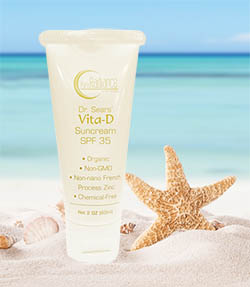
The name of this revolutionary new sunscreen is Vita-D Sun Cream. And it should be your first choice in sun care.
When you smooth Vita-D Sun Cream onto your skin, you are not only protecting against the sun’s harmful rays, you are also enriching your body with all the healthy benefits of vitamin D.
- Strong bones and teeth
- Immune system support
- Protection against diabetes 23, 24
- Support for brain and nervous system
- Protection against heart disease 25
- Protection against premature death 26
- Increased muscle strength 27
- Protection against age-related mental decline 28
- Protection against cancer
Vita-D Sun Care is the best of both worlds: Anti-aging sun protection and health-bestowing vitamin D. Because as important as vitamin D is, it isn’t the only benefit you’ll find in Vita-D Sun Care. It also gives you:
Skin-protecting and anti-aging benefits that help keep your skin young and beautiful.
The all-natural ingredients in Vita-D Sun Cream combine to give you the best anti-aging sunscreen available:
- Provides optimal 35 SPF protection, blocking a full 97% of the sun’s harmful UVB and UVA rays 29
- Replenishes essential vitamin D to your body
- Gives you effective protection from photoaging
- Protects against free radical damage that rapidly ages you
- Spreads smoothly and easily on your skin
- Resists washing off by perspiration or water
- Does not leave a white film on your skin
- Can be worn easily under makeup
- Is paraben-free
- Is fragrance-free
- Will not clog pores
- Non-nano formula means ingredients do not enter your bloodstream
- Is completely petrochemical-free
 |
In fact, Vita-D Sun Cream offers you more benefits than both the leading brands and the most expensive sunscreens.
And what Vita-D Sun Cream does not have is important too…
75% of sunscreens contain toxic ingredients!
Almost all sunscreens are toxic dumps of noxious poisons that the FDA refuses to take off the market.
The Environmental Working Group tested more than 2,000 sunscreens and found that 75% of the formulas contain toxic chemicals.30
What’s more, their study found that nearly half of the 500 most popular sunscreens could actually increase the speed at which malignant cells develop and spread deadly skin cancer.
My patients are always shocked when I tell them about one of the most toxic ingredients: Vitamin A.
Speeds the development of cancerous tumors.
You might think that having a natural ingredient like vitamin A in your sunscreen would be a good thing.
But studies suggest that two forms of vitamin A called retinyl palmitate and retinoic acid that are common in sunscreens may speed the development of cancerous tumors. And other forms of vitamin A can turn toxic on your skin when exposed to the sun.31
That’s not the only dangerous ingredient, either:
- One very common ingredient called oxybenzone is an endocrine disruptor, and is associated with a painful disorder called endometriosis in women. Fertility problems can be the result. Oxybenzone also causes the formation of free radicals that damage cells. 32
- Another common ingredient called octinoxate can negatively affect your reproductive system and thyroid.
- A third common ingredient called homosalate disrupts the hormones estrogen, androgen, and progesterone in your body.
Some of the most popular brands contain these toxic ingredients. But you won’t have to worry about toxicity with Vita-D Sun Care.
Vita-D Sun Cream contains pure, natural ingredients that protect you from UVB and far more dangerous UVA rays.
 |
My new Vita‐D Sun Cream gives you thorough protection from the sun’s harmful rays — without any of the dangerous chemicals in other sunscreens.
With an SPF of 35, Vita-D Sun Cream blocks out 97% of the sun’s UVB rays, which are the primary cause of sunburn. Don’t be misled by products with an SPF of 50 or 100. Those products only provide 1% and 2% more protection than an SPF of 35.
More importantly, SPF only measures protection against UVB rays, not the far more dangerous UVA rays. Those are the rays that cause skin cancer and skin aging.
To protect against UVA rays you need a physical block like zinc oxide. Which is exactly what you’ll find in Vita-D Sun Cream . But that’s not all you’ll find in my new suncream.
Vita-D Sun Cream is as pure as the sun, giving you only nature’s ingredients to protect and nourish your skin. Including:
Natural Vitamin D3 to keep you healthy all over
Vitamin D can come in several forms, either vitamin D2 or D3. The kind typically prescribed by doctors or found in supplements is D2. The kind you’ll find in Vita-D Sun Care is D3.
Research shows that vitamin D3 is about 87% more potent than D2. 33 What’s more, D3 is stored by your body in three times greater concentrations than D2.
A meta-analysis of 50 trials found that vitamin D3 reduces your risk of death from all causes. Results of the analysis showed that there is a 6% lower risk of mortality among those subjects taking D3, compared to a 2% increased risk among those taking D2.34
But vitamin D isn’t the only sun-protective ingredient you’ll find in Vita-D Sun Care. To give you the best sunscreen experience possible, it also contains natural oils and nutrients that protect your skin and provide anti-aging benefits. Including:
Zinc oxide for complete sun protection
To give you the best protection possible, Vita-D Sun Care contains 25% zinc oxide, the most effective sun block there is, and the only sunscreen that is FDA-approved for children under six months of age.
The kind of zinc oxide used in Vita-D Sun Care does not create a white film on your skin like some zinc oxides do, either. Instead, it smooths to an invisible layer of protection to block out sunburn and help prevent skin aging.
What’s more, the zinc oxide in Vita-D Sun Care does not break down in the sun, which means it offers long-lasting protection. And it gives you better protection from the sun’s ultraviolet rays than any other sunscreen ingredient today. 35
It even provides better protection than titanium dioxide, and unlike titanium dioxide, it does not form free radicals that can damage your skin.36
Organic extra virgin olive oil for deep moisture and protection against photoaging
Olive oil provides a natural emollient base for Vita-D Sun Care. It keeps your skin naturally hydrated and smooth, and guards against dermatitis.37
It is also one of nature’s best sunscreens. It has a higher SPF than castor oil or sesame oil, both of which are popular natural sunscreen bases. What’s more, olive oil is associated with a lower risk of severe photoaging.38
While most sunscreens are based on hydrocarbon oils from petroleum products, Vita-D Sun Cream ’s olive oil base is light and easily absorbed by your skin.
Non-GMO vitamin E to protect your DNA from sun damage
Vitamin E helps protect your DNA from sun damage.39 Photodamaged DNA can lead to mutations and genetic instability, which is one of the reasons why exposure to sunlight increases the risk of skin cancer.40 It works by absorbing the energy from ultraviolet light, preventing UV-induced free radical damage to your skin.
Free radicals are molecules that cause cell oxidation. If you’ve ever seen an apple turn brown after it’s cut, that’s the result of oxidation. The same damage happens to your skin when the sun’s UV rays create free radicals. But the vitamin E in Vita-D Sun Cream gives you the best protection against free radical oxidation.
Finally, there are two more ingredients in Vita-D Sun Cream . One is pure artisanal water, which helps give the cream a soft, smooth, luxurious texture. The other ingredient is:
Organic Beeswax to reduce moisture loss and sooth dry skin
Every time you’re in the sun your skin loses moisture and essential oils, drying it and aging it to a rough, flaky appearance and feel.
That’s why Vita-D Sun Cream contains beeswax, to help reduce moisture loss and keep your skin plump and dewy. Beeswax also offers an immediate soothing effect on minute cracks and fissures in your skin that you probably don’t even know are there.
Beeswax gives your skin a protective barrier against environmental assaults, too. But unlike petroleum, it doesn’t suffocate your skin or clog pores. And if you suffer from dry skin, you’ll like that beeswax helps sooth itching.
Together, these ingredients give you what I believe is the best, most advanced, most protective anti-aging sunscreen available anywhere. That’s why I urge you to:
Try Vita-D Sun Cream today and protect your skin the right way!
 |
You’ve just seen that sunscreen is linked to many diseases and illnesses.
You’ve seen that it can actually age your skin instead of protecting it.
You’ve seen that sunscreen blocks production of vitamin D, one of your body’s most important hormones.
And you’ve seen what kind of damage low vitamin D can have on your health — putting you at risk for everything from cancer to skin aging.
So really, if you want to protect your body from sun damage and vitamin D deficiency, you really only have one choice: Vita-D Sun Cream, a revolutionary sunscreen that is full of healthful ingredients…with no dangerous toxic ingredients.
Plus Vita-D Sun Cream is more than a sunscreen. It is an also an anti-aging cream full of antioxidants and oils that help keep your skin young and supple, free from the age spots, wrinkles, and sagging that are caused by too much sun exposure.
Vita-D Sun Cream is an incredibly affordable investment in your skin’s health.
You can find sunscreens at bargain prices. But those contain cheap toxic ingredients that are dangerous to your health. In fact, even the most expensive sunscreens contain these same toxic ingredients!
None of them have the power to restore vitamin D to your body either. Instead they rob you of that essential hormone.
And drug store or department store sunscreens don’t contain enriching anti-aging or moisturizing ingredients. Some of them even act as an astringent, pulling moisture from your skin the same way the sun does.
Go ahead and try Vita-D Sun Cream for 30 days. See how it protects you from sunburn. Feel how it smooths and softens your skin even as it protects you from skin aging and skin cancer.
Discover how much better you feel as your body starts producing vital vitamin D hormone once again. You’ll feel fatigue and muscle weakness disappear. You’ll sense your mood getting brighter, your brain getting less sluggish.
And you’ll have peace of mind knowing that every time you put on sunscreen you’re not filling your body with toxic chemicals or robbing yourself of a vital hormone.
A special offer for first-time buyers!
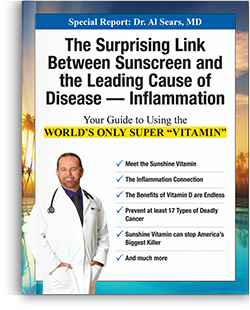 |
Vita-D Sun Cream today and you’ll not only get FREE shipping and handling, but I’ll also send you my bestselling report, The Surprising Link Between Sunscreen and the Leading Cause of Disease — Inflammation, free, a $19.95 value!
The secrets you’ll discover in this special report will give you everything you need to know about vitamin D, including:
- Why vitamin D is the real fountain of youth
- How vitamin D deficiency puts you at risk for cancer
- Why your dermatologist is wrong about the sun’s dangers
- How the sun makes vitamin D in your body
- The surprising link between low vitamin D and disease
- And more!
Plus, if you order today, you can save 30% off the regular price of Vita-D Sun Cream.
| Ultimate Deal — VIP Auto Delivery Program
Get 3 tubes of Vita-D Sun Care and save 30%! Pay just $34.95 per tube. Plus, along with your order, you’ll join my VIP Auto Delivery Program where you’ll get FREE Shipping and the discounted price per tube for as long as you continue to use Vita-D Sun Cream. Plus you get my FREE special report, a $19.95 value, and FREE shipping & handling. Here’s how it works: We’ll deliver 3 tubes of Vita-D Sun Cream every 90-days so you never have to worry about running out or reordering. As a member of the VIP Auto Delivery Program, for each shipment (every 90-days), your credit card will be automatically charged. You can update your shipment schedule based on your personal use at any time. You pay only $104.85, a total savings of over $75 with FREE shipping and your FREE report!
|
||
| Great Deal Save 20% when you order 3 tubes of Vita-D Sun Cream for just $39.95 per tube plus Shipping and Handling. Plus you get my FREE special report. You pay only $119.85, plus shipping, for a total savings of almost $50! |
||
| Trial Offer When you order 1 tube of Vita-D Sun Cream for $49.95 plus shipping and handling. |
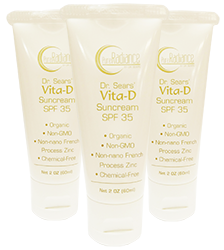
No matter which offer you choose, you’re getting the most revolutionary new sunscreen today‐the only sunscreen you should use from now on! Save your skin, save your health‐try Vita‐D Sun Cream today!
Click HERE to view Primal Force Products catalog.
Click HERE to view Pure Radiance Products catalog.
Here to view Dr Al Sears, MD Wellness Center
REFERENCES
1 S Hussain, Sunscreen Causes Cancer: New Study Confirms, Consumer Health Digest
2
Churilla T., et al. “Serum vitamin D levels among patients in a clinical oncology practice compared to primary care patients in the same community: a case‐control study.” British Medical Journal. Dec 2011.
3
A McNeill, MD et al. “Sun Protection and Vitamin D.” The Skin Cancer Foundation Journal. May 18, 2016.
4
Kostoglou-Athanassiou I., et al. “Vitamin D and rheumatoid arthritis.” Therapeutic Advances in Endocrinology and Metabolism. Dec 2012.
5 Schwalfenberg G., “Vitamin D and diabetes.” Canada Family Physician. June 2008.
6
Judd S., et al. “Vitamin D Deficiency and Risk for Cardiovascular Disease.” American Journal of Medicine and Science. July 2009.
7
Penckofer S., et al. “Vitamin D and Depression: Where is all the Sunshine?” Issues in Mental Health Nursing. June 2010.
8
Knekt P., et al. “Serum 25-hydroxyvitamin d concentration and risk of dementia.” Epidemiology. Nov 2014.
9
Roy S., et al. “Correction of Low Vitamin D Improves Fatigue: Effect of Correction of Low Vitamin D in Fatigue Study (EViDiF Study).” North American Journal of Medicine and Science. Aug 2014.
10
Soni M., et al. “Vitamin D and cognitive function.” Scandinavian Journal of Clinical and Laboratory Investigation. 2012.
11
Lowe G., et al. “Increasing Incidence of Melanoma among Middle-Aged Adults: An Epidemiologic Study in Olmsted County, Minnesota.” Mayo Clinic Proceedings. Jan 2014.
12
Nonmelanoma Skin Cancer Incidence Increases Dramatically, Skin Cancer Foundation, April 27, 2010.
13
Lens M, et al. “Global Perspectives of Contemporary Epidemiological Trends of Cutaneous Malignant Melanoma.” The British Journal of Dermatology. 2004.
14
Hanson K., et al. “Sunscreen enhancement of UV‐induced reactive oxygen species in the skin.” Free Radical Biology and Medicine. Oct 2006.
15
Ginde A., et al. “Demographic Differences and Trends of Vitamin D Insufficiency in the US Population, 1988—2004.” Archives of Internal Medicine. March 2009;
16
Staud R. “Vitamin D: more than just affecting calcium and bone.” Current Rheumatology Reports. Oct 2005.
17
Laino C. “Low Vitamin D Levels Linked to Advanced Cancers.” Oct 4, 2011.
18
Naeem Z. “Vitamin D Deficiency — An Ignored Epidemic.” International Journal of Health Sciences. Jan 2010.
19
McNeill, A., et al. “Sun Protection and Vitamin D.” The Skin Cancer Foundation Journal. May 18, 2016.
20
Fernandes, D. “Is sunscreen causing more free radical damage to your skin?” ProfessionalBeauty.com.au. Nov 18, 2008.
21
Reichrath J. “Unravelling of hidden secrets: The role of vitamin D in skin aging.” Dermatoendocrinology. July 2012.
22
Chang A., et al. “Association of facial skin aging and vitamin D levels in middle-aged white women.” Cancer Causes and Control. Dec 2010.
23
Zipitis C., et al. “Vitamin D supplementation in early childhood and risk of type 1 diabetes: a systematic review and meta-analysis.” Archives of Disease in Childhood. June 2008.
24
Chiu K., et al. “Hypovitaminosis D is associated with insulin resistance and beta cell dysfunction.” American Journal of Clinical Nutrition. May 2004.
25
Giovannucci E., et al. “25-hydroxyvitamin D and risk of myocardial infarction in men: a prospective study.” Archives of Internal Medicine. June 2008.
26
Schottker B., et al. “Vitamin D and mortality: meta-analysis of individual participant data from a large consortium of cohort studies from Europe and the United States.” British Medical Journal. June 2014.
27
Tomlinson P., et al. “Effects of vitamin D supplementation on upper and lower body muscle strength levels in healthy individuals. A systematic review with meta-analysis.” Journal of Science and Medicine in Sport. Sept 2015.
28
Llewellyn D., et al. “Vitamin D and risk of cognitive decline in elderly persons.” Archives of Internal Medicine. July 2010.
29 S Wang, MD, Ask the Expert: Does a higher SPF (sun protection factor) sunscreen always protect your skin better? Skin Cancer Foundation
30
J Axe, M.D., The Dangers of Conventional Sunscreens, draxe.com
31
The Problem with Vitamin A, Environmental Working Group
32
CDC: Americans Carry Body Burden of Toxic Sunscreen Chemical, Mar 25, 2008, Environmental Working Group
33
Heaney R., et al. “Vitamin D3 is More Potent than Vitamin D2 in Humans.” Journal of Clinical Endocrinol Metabolism. 2011.
34
Bjelakovic G., et al. “Vitamin D supplementation for prevention of mortality in adults.” Cochrane Database System Review¸ July 2011.
35
Nanoparticles in Sunscreens, Environmental Working Group
36
Ibid
37
U Kiechl-Kohlendorfer et al, The effect of daily treatment with an olive oil/lanolin emollient on skin integrity in preterm infants: a randomized controlled trial, Pediatric Dermatology, Mar-Apr 2008; 25(2): 174-8
38
Latreille J., et al. “Dietary Monounsaturated Fatty Acids Intake and Risk of Skin Photoaging.” PLoS One. 2012.
39
McVean M., et al. “Prevention of DNA photodamage by vitamin E compounds and sunscreens: roles of ultraviolet absorbance and cellular uptake:” Molecular Carcinogenesis. March 1999.
40
Marrot L., et al. “Skin DNA photodamage and its biological consequences.” Journal of the American Academy of Dermatology. May 2008.
foots
 |
To learn more about Pure Radiance, Inc., call (888) 795-4005 or visit:
www.PureRadiance.com
For a Limited time
BUY 2 BOTTLES OF OMEGA REJUVENOL
GET THE THIRD BOTTLE FREE


Timeless Beauty
Comes From Nutrients
You Have With-In
Buy 3 Save 40%,
Get Free Shipping
And Three Gifts
BUY 2 BOTTLES OF MOBILIFY
GET THE 3rd FREE

Give Youre Face
A Fresh, Youthful Appearance
With Regenesis